
The Man From High River
The most Canadian of Canadians: Joe Clark

This newsletter tries not to take specific positions. Yet there is one opinion about which I am unabashed: my love of the Rt. Hon. Charles Joseph Clark, the most Canadian of Canadians.
There is something so Canadian about Joe Clark, with his mix of accomplishments, failures and even humiliations, but also his indomitable spirit and one thing that has never been challenged: his essential goodness. Over the years many have asked if Joe Clark was the right person for the job or was making the right decisions, but it’s hard to find anyone who dislikes the guy himself or questions his intentions; if they do, it’s worth questioning their own.
A Joe Clark bio: Born in 1939 in High River, just south of Calgary, he was a bright student at the University of Alberta and highly active in the PC Party, where he met other hustling young Tories like Brian Mulroney. He first ran for office in the 1967 Alberta provincial election and later came to Ottawa to work for Mr Stanfield. He was elected to Parliament in 1972, and soon took an audacious risk and unexpectedly won the party leadership in 1976 at the age of 36; the famous Toronto Star headline the next day read Joe Who?
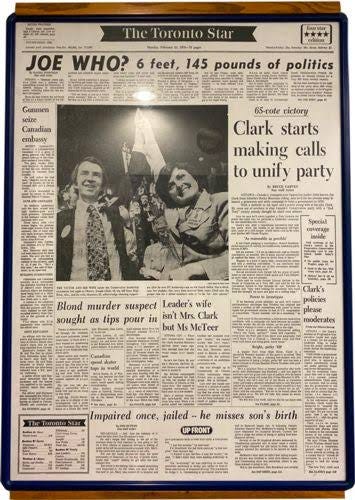
Then the struggles began. Right-wingers in the caucus, egged on by the disloyal Chief, challenged his authority. Clark’s masculinity was mocked because his wife, Maureen McTeer, retained her last name. His gravitas was undermined by minor mishaps, most famously losing track of his luggage on an international trip designed to bolster his statesman image. Clark managed to win the most seats in the 1979 election, but was 4% behind Pierre Trudeau’s Liberals in the popular vote; a very weak mandate. He nevertheless tried to lead boldly and aggressively, making what civil servants call “courageous” decisions (i.e, foolhardy), but the government was defeated in a non-confidence vote, and Trudeau - who had announced and then rescinded his resignation - steamrolled him in the subsequent election.
Clark hung on to the leadership despite an open campaign by Mulroney to eject him; in the 1983 leadership review, Clark received 67%, which he deemed insufficient, having received a similar level in 1981. Once again choosing the bold move, he stepped down to run for a new mandate as leader, but was defeated by Mulroney. In late 1983, Joe Clark was looking pretty washed up.
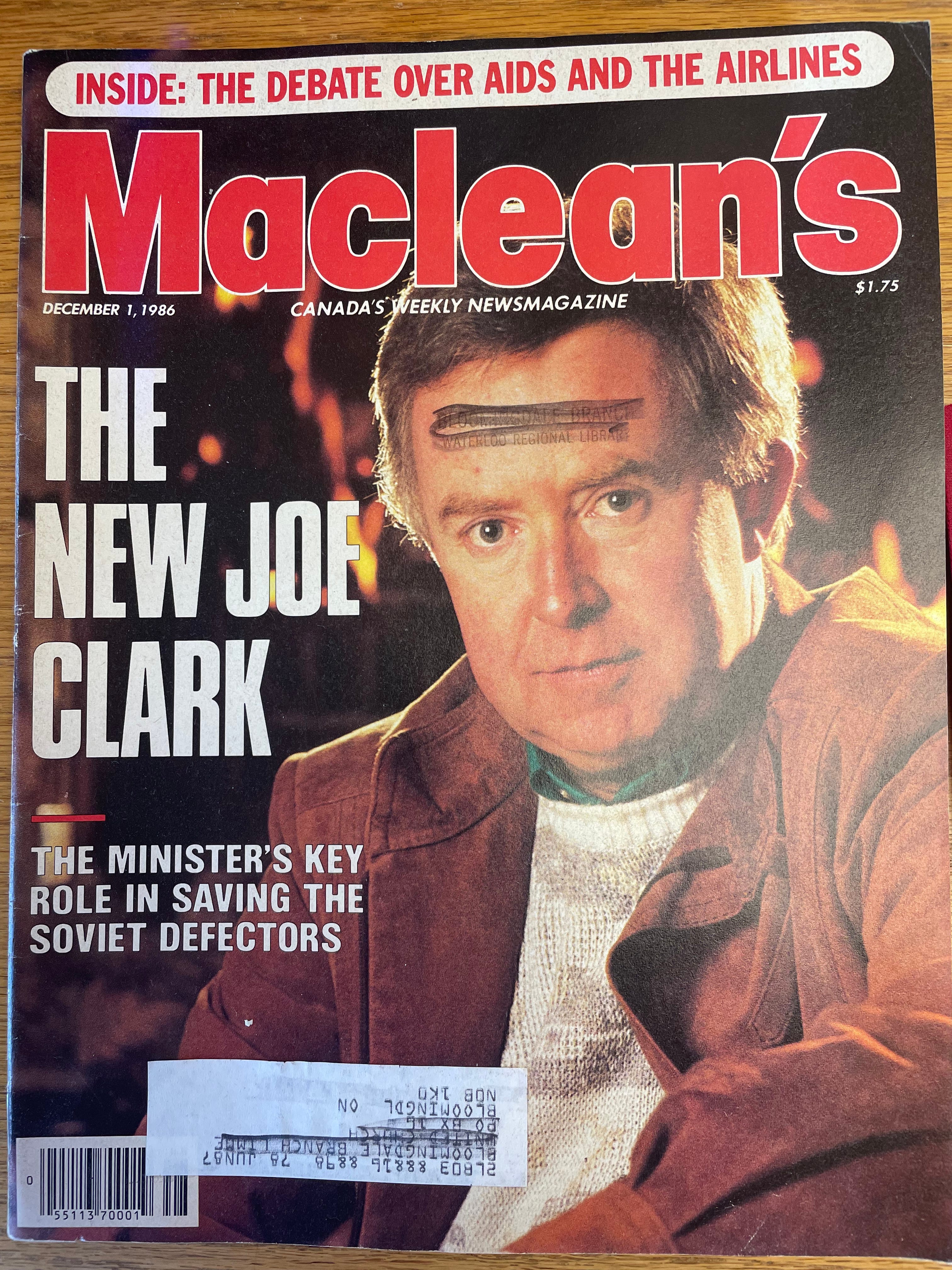
But he hung on. Named Minister of External Affairs by the selectively magnanimous Mulroney, Clark found his groove, became “The New Joe Clark” and finally started to look like a statesman. He was then handed the bomb of Minister of Constitutional Affairs, where he dug deep with all his knowledge and experience of the country to try and find consensus, picking up the nickname “Captain Canada.” He stepped down from politics in 1993, spent a few years filling time with Joe Clark-style jobs like UN representative to Cyprus, and then came back in 1998 to again lead the much-diminished PC party, now fighting for its life against Reform. Clark refused to give in to Reform’s right-wing populism and its claim to speak for the West. Taking another bold risk, he ran and won in a Calgary seat in the 2000 election and kept the PCs alive and in good spirits, setting the party up for his successor Peter MacKay to negotiate an equal partnership in the reunited Conservative Party of Canada. But Clark himself never joined the new party, seeing it as too right-wing. He’s been out of active politics since 2004, but not public life, and while now 87, still pops up from time to time.
Clark has much in common with his contemporary Jimmy Carter; another middling chief executive whose best public contributions came after leaving office. Clark’s resilience amid setbacks is impressive; he’s very durable. But to me what really sets Clark apart, and truly makes him so Canadian, are his human imperfections alongside his accomplishments.
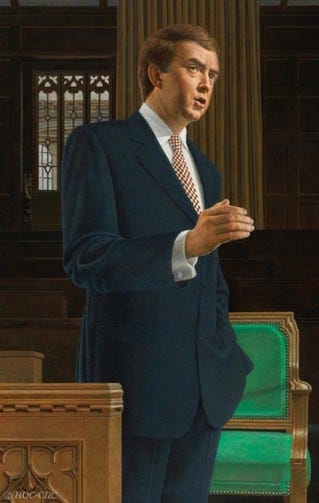
Clark has an inherent awkward formality that long made him the most unintentionally funny figure in Canadian politics; readers of a certain age will recall CBC’s “Double Exposure”, in which Bob Robertson did a terrific impression of Clark, with a very recognizable “Uh, Uh, Uh” laugh and many “Indeed”s. Listen here for Robertson, and watch here for Don Ferguson’s Royal Canadian Air Farce impression. In Clark’s official portrait, showing him speaking in the House, I can’t help but notice that it looks like he’s talking to an empty chamber. Combined with indignities like lost luggage, he is comedy gold.
But let’s face it: no one for a second doubts the essential goodness of Joe Clark. There are no envelopes stuffed with cash, embarrassing inquiries, half-strangled protestors, upraised fingers, or fuddle-duddles. His imperfections only emphasize that his errors are ones of execution, not character, and he has a stubborn moral compass, seen in his refusal to let bygones be bygones and join the CPC.
Clark’s failures, most notably his prime ministership, are usually from trying to play a role that doesn’t suit him: the decisive, iron-fisted, damn-the-torpedoes leader. Clark’s true instinct is to take time to listen, weigh evidence, and pursue consensus, guided by that moral compass. One of his longstanding phrases is that Canada is “a community of communities,” and while it received Trudeauian scorn, it speaks to a fundamentally collective and interdependent view of society. Clark conveys very much a Canadian style of leadership which, combined with his unintentional funniness, makes him the embodiment of our imperfect nation.
Joe Clark is also a package deal. His partnership with Maureen McTeer, who boasts her own accomplishments, has no real parallel in Canada - McTeer remains the only prime ministerial spouse to not change their name or to run for Parliament, as she did unsuccessfully in 1988 - and they are often recognized as a team; in 2010 at Carleton University, we rightly awarded honorary degrees to both of them in the same ceremony. McTeer is a fascinating person in her own right who from the start continued to cultivate her own career separate from Clark. She was finishing law school when Clark won the party leadership, articled while he was preparing for the 1979 election, and wrote her final bar exams days before the 1980 election, all while raising Catherine Clark, born in 1976.
(Maureen McTeer took a lot of crap for her feminism, and much in turn landed on Clark. My own tiny story: when Joe Clark announced his first departure from politics in 1993, I happened to be in Edmonton, where the Ontario Legislative Interns were visiting the Legislative Assembly of Alberta. At a reception I found myself talking with the Deputy Speaker and, searching for suitable conversation, I noted Clark’s announcement. He paused, leaned back and smiled, and distinctly said “yep, Mr McTeer’s gone.” I was only 22 but I hope my WTF face was obvious. I later understood I’d been talking to Stan Schumacher, a former MP and Diefenbaker sycophant who had refused to give up his seat to his new leader after the 1976 riding redistribution moved High River into it, forcing Clark to run elsewhere. In a deserved outcome, the three-term Schumacher then got knocked off in his own local nomination, later crawling into provincial politics.)
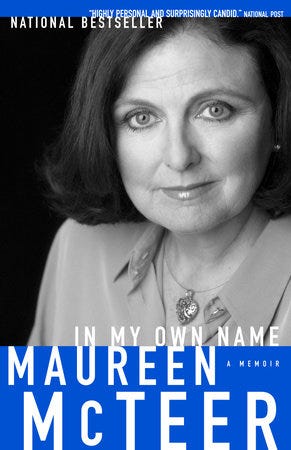
There remains no Joe Clark biography, excepting David Humphrey’s Joe Clark: A Portrait (1978), which needs one or two updates. (There are two good contemporary books on the Clark government: Jeffrey Simpson’s Discipline of Power and Warner Troyer’s 200 Days: Joe Clark in Power; also 1978’s Joe Clark: The Emerging Leader, by Michael Nolan, an impressive and lavishly illustrated book answering the question in the Toronto Star headline). Clark himself has written two policy-oriented books but never his own memoir, though one can obtain A Man of Parliament: Selected Speeches from Joe Clark, co-edited in 2019 by my political science colleague Jonathan Rose. This thin library itself says something about a very Canadian modesty, with Clark himself apparently unconcerned about controlling his own personal story, unlike most ex-prime ministers. (Maureen McTeer’s autobiography, In My Own Name, was published in 2003 and remains an excellent read. On p. 133, after the 1980 defeat, she writes: “…people were already beginning to write and rewrite history to ensure their part was portrayed in a positive light. Joe has never given much attention to this aspect of public life.”)
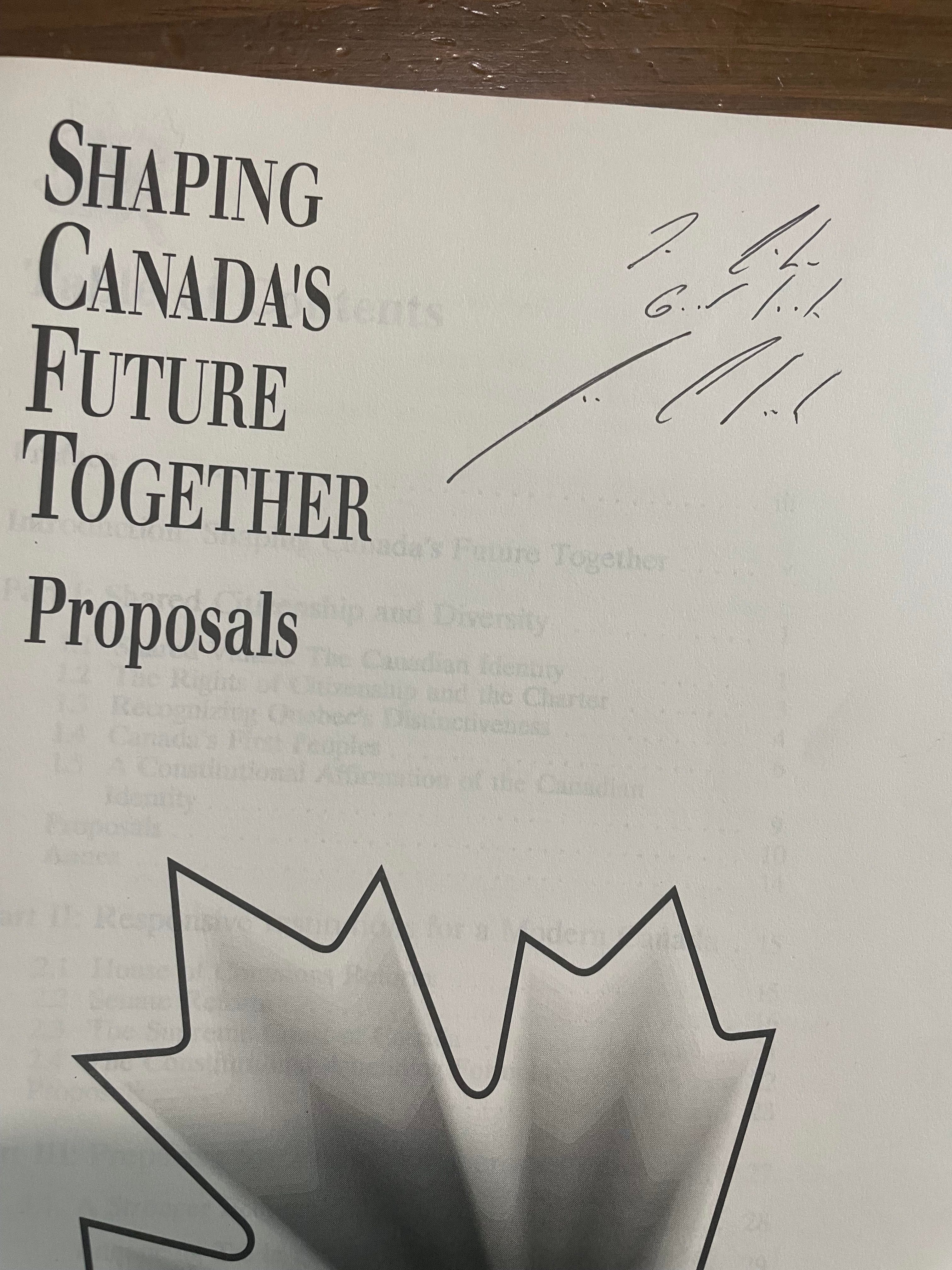
Returning again to a personal note, I first met Joe Clark when he came to the University of Waterloo in the fall of 1991 to talk up the latest round of constitutional proposals, arranged by my professor Peter Woolstencroft, a Clark man from U of A days. I still have my signed copy.
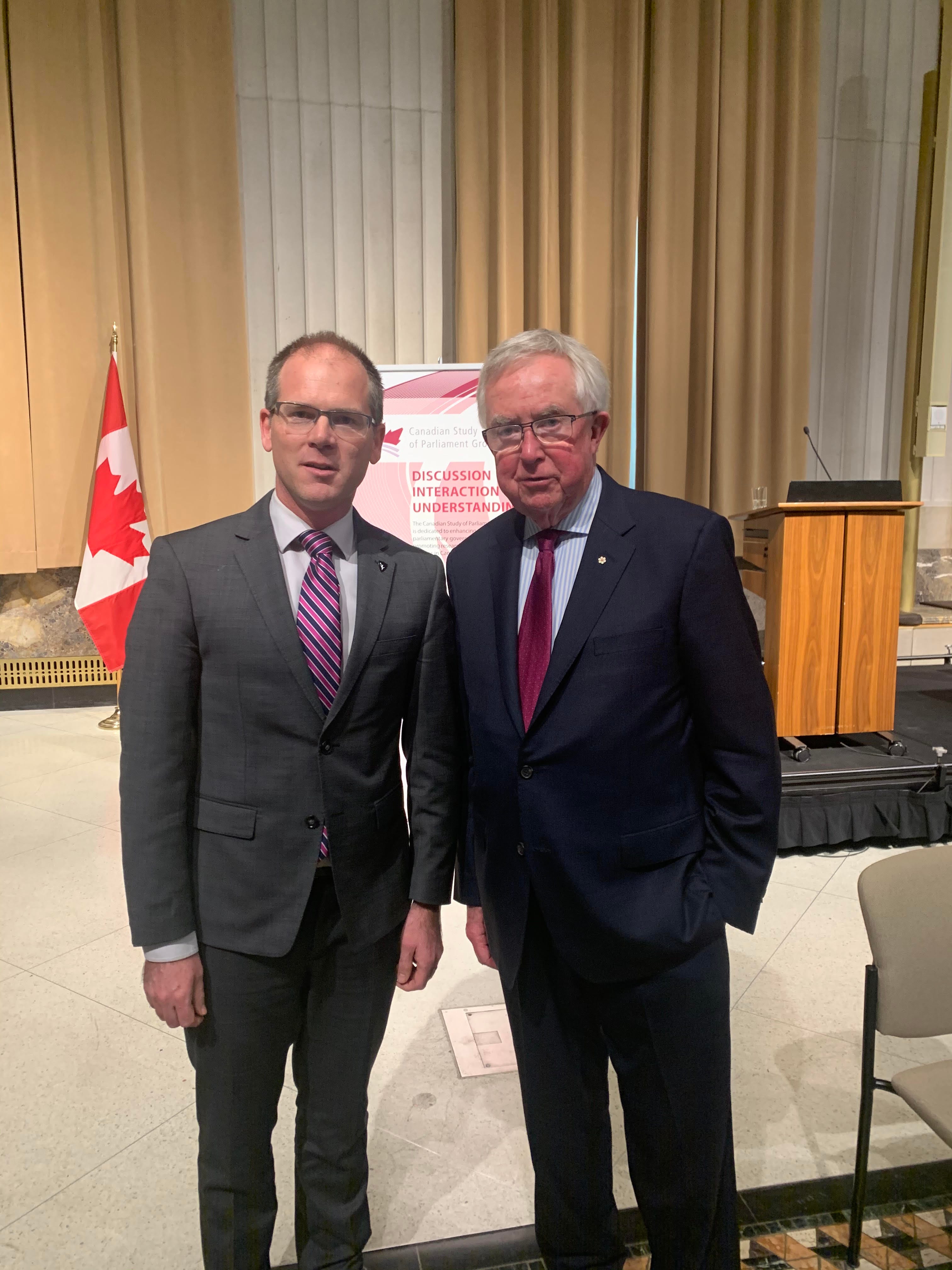
In more recent years I’ve had occasion to chat with him a couple of times at events in Ottawa. I’m very proud of this picture of me with Man From High River - in my view, the most Canadian of Canadians.
Great piece! There's a Clark biography coming this fall: https://www.linkedin.com/posts/matthew-hayday-208002a_im-delighted-to-share-the-jacket-design-share-7481072326848184321-Sx5y/
I've often regretted Mr. Clark's loss of confidence in the house and the subsequent election loss but to your point, it all creates the theme of your article and you are correct in his being the quintessential Canadian.
Thank you for the reminder Jonathan.